Most leads are not lost because the product was wrong or the price was too high. They are lost because the follow-up was mishandled. A prospect showed real interest, asked a real question, and somewhere between that first message and a decision, the conversation fell apart — not because they changed their mind, but because the business stopped giving them a reason to stay engaged.
WhatsApp makes follow-up easier than almost any other channel, which is exactly why the mistakes on this channel are so costly. The expectation of speed and relevance is higher here than on email or phone. A clumsy follow-up on WhatsApp does not just fail quietly — it actively damages how the prospect sees the business, often ending in a block rather than a polite non-response.
Here are the follow-up mistakes that show up most consistently across businesses running WhatsApp campaigns, and what fixing them actually looks like.
Mistake One: Following Up Too Slowly
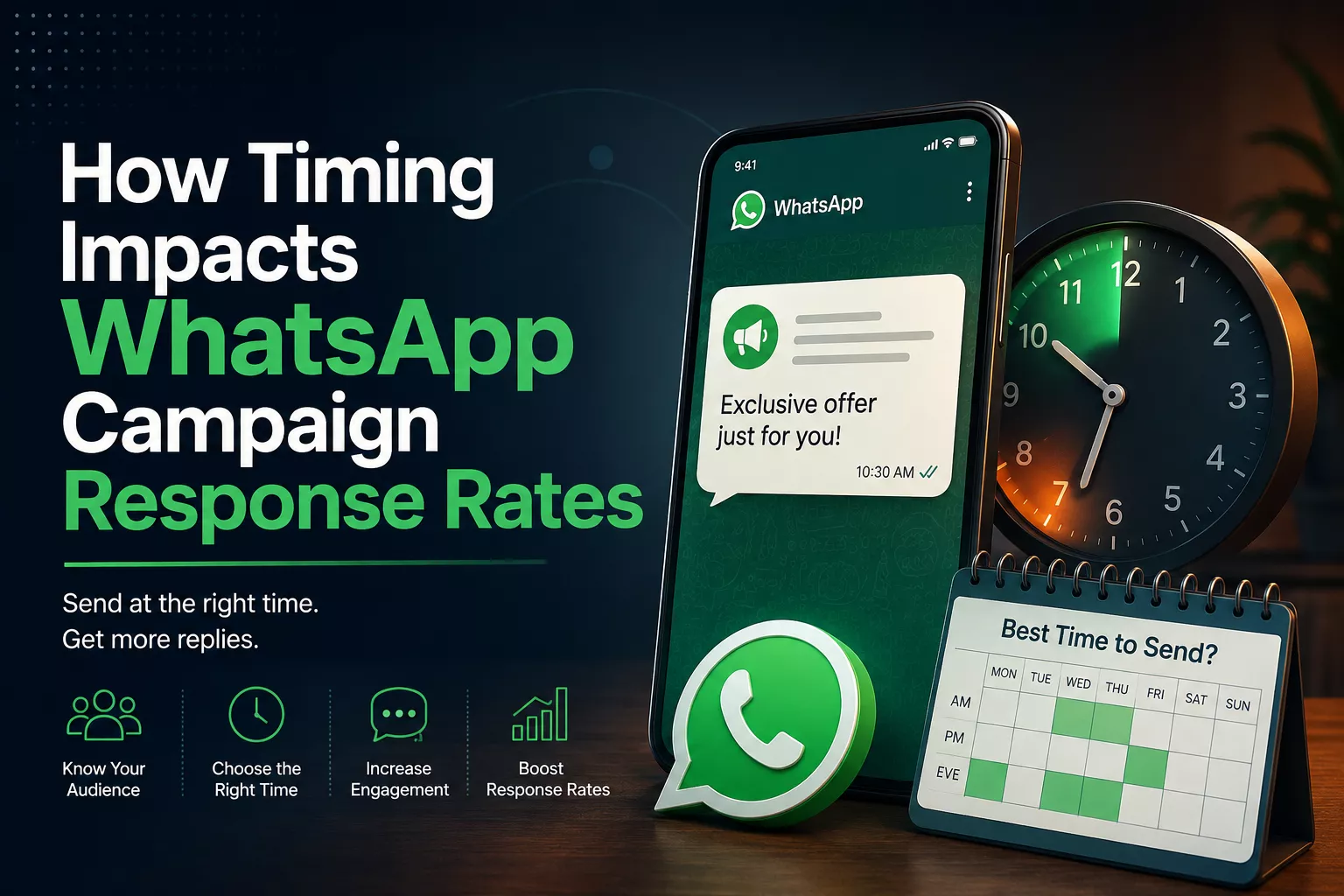
A prospect replies to your campaign with interest. Nobody responds for four hours. By the time someone does, the prospect has either lost the urgency they felt in the moment or has already started a conversation with a competitor. On WhatsApp specifically, this delay reads worse than it would on email, because the entire channel runs on an expectation of near-immediate exchange.
The fix is not asking your team to be faster. It is removing the dependency on a human being available the second a reply comes in. Automated reply flows acknowledge inbound messages instantly, ask the next relevant question, and keep the conversation moving while a human agent is alerted and brought in. The prospect never experiences silence, even if the dedicated agent does not see the message for twenty minutes.
A real estate firm that used to lose leads to four-hour response gaps set up an automated flow that responds within seconds to any inbound enquiry, asks budget and location preference, and only then routes to an agent. The prospect feels engaged from message one. The agent gets a warmer, more qualified conversation by the time they join.
Mistake Two: Sending the Same Message Twice (or Three Times)
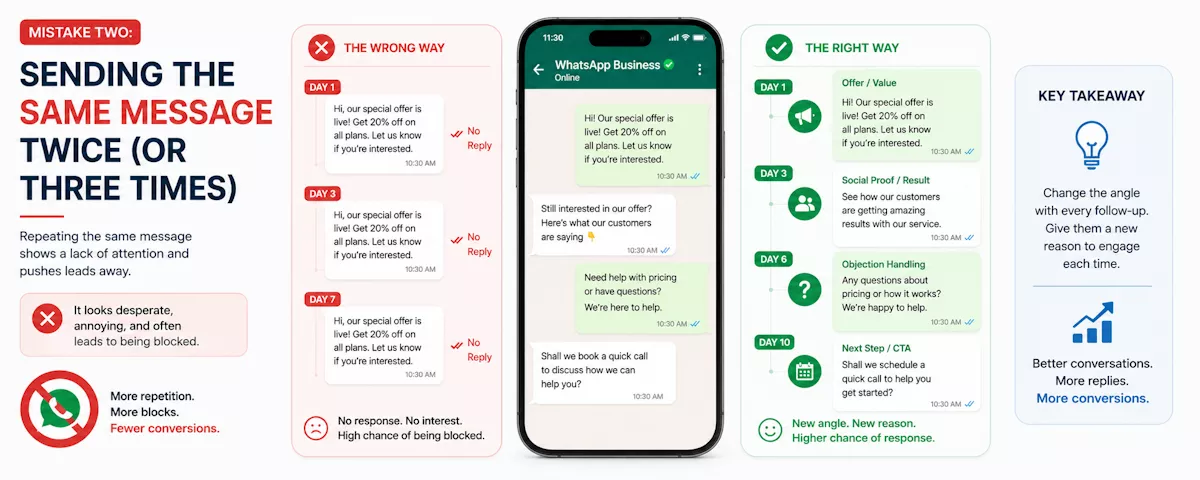
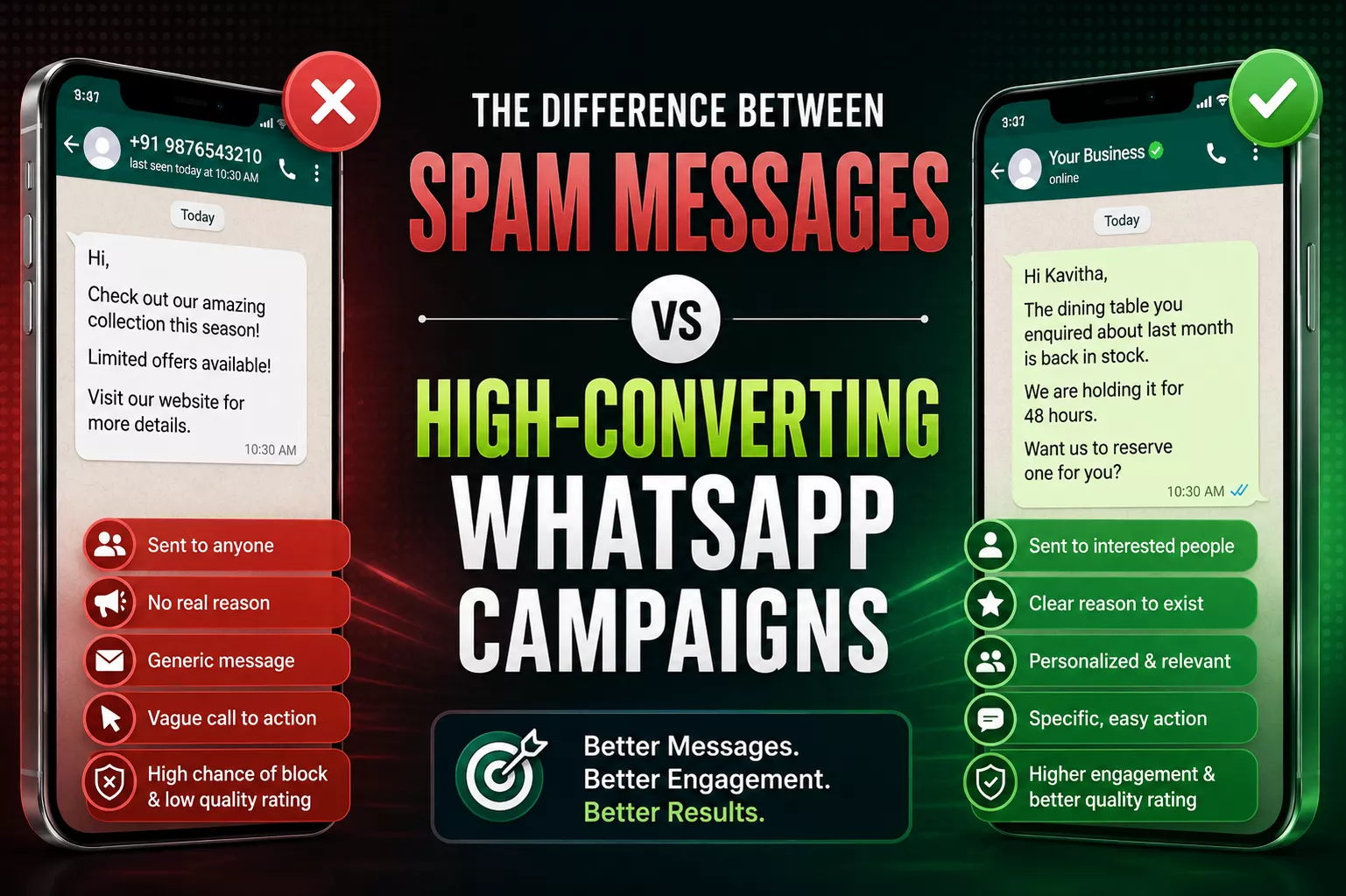
A prospect does not reply to the first follow-up. Three days later, they get the exact same message again. Then again a week after that. This is the single fastest way to get reported and blocked on WhatsApp — repetition reads as desperation or, worse, as the business not paying attention to the fact that the first message did not land.
Effective follow-up sequences change the angle with every touchpoint. The first message states the offer clearly. If there is no response, the second message — sent a few days later — might share a customer result or testimonial instead of repeating the pitch. The third, if needed, might address a likely objection directly: ‘Wondering about pricing or timelines? Happy to walk you through it.’ Each message gives the prospect a new reason to engage rather than repeating one they already chose not to act on.
This requires planning the sequence before the first message goes out, not improvising message two after message one fails. At 24/7 Marketing, follow-up sequences are mapped and built into the template library upfront — three to four distinct messages, each approved and ready to deploy at the right interval, so no one is scrambling to write a generic repeat message under time pressure.
Mistake Three: No System for Tracking Who Needs a Follow-Up
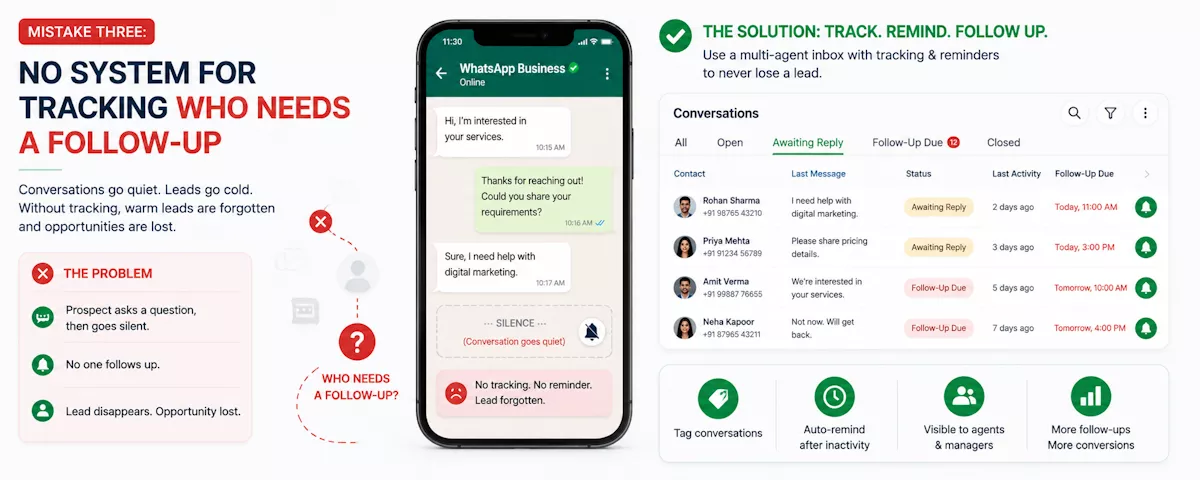
A prospect asks a question on a Tuesday. The agent answers. The prospect does not reply again. Nobody follows up because nobody is tracking that the conversation went quiet mid-thread. The lead simply disappears — not because they were uninterested, but because there was no system flagging that this conversation needed a nudge.
This is one of the most common and most invisible failures in WhatsApp-based sales processes. Conversations are managed reactively — agents respond when a message comes in, but nothing prompts them to check back on threads that went silent. Over weeks, dozens of warm conversations quietly go cold simply because no structure existed to surface them again.
A multi-agent inbox with status tracking solves this directly. Conversations can be tagged as ‘awaiting response’ and automatically surfaced after a set period of inactivity — two days, three days, a week, depending on the business. Supervisors get visibility into how many conversations are sitting unresolved and can ensure they are actioned rather than forgotten. The lead does not vanish into an agent’s personal memory of who they were supposed to message back.
Mistake Four: Making the Prospect Repeat Themselves
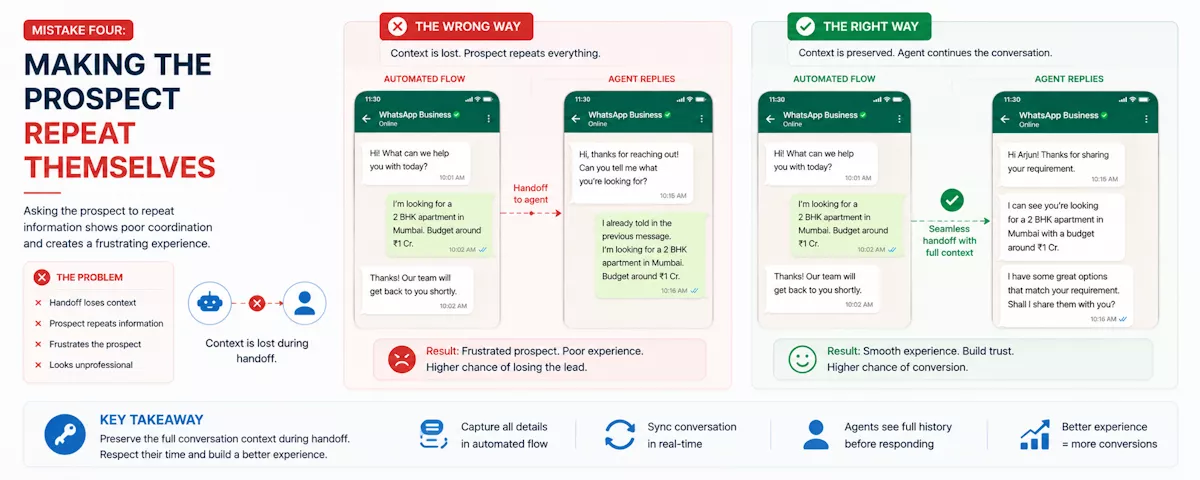
A prospect explains their requirement to an automated flow. The flow hands the conversation to an agent. The agent’s first message: ‘Hi, thanks for reaching out, can you tell me a bit about what you’re looking for?’ The prospect just answered that question two minutes ago. Now they answer it again, more impatiently.
This happens constantly when automation and human follow-up are not properly connected. The handoff loses context, and the prospect pays the price by having to re-explain something they already provided. It is a small thing that produces an outsized negative reaction, because it signals the business was not actually listening the first time — even though, technically, the system was.
A properly built multi-agent inbox preserves the full conversation thread, including everything captured during an automated flow. When an agent picks up the conversation, they see exactly what the prospect already shared. Their first message reflects that: ‘Hi Arjun, I can see you are looking for a 2BHK in Whitefield with a budget around 80 lakhs — let me pull a few options that match.’ No repetition. No friction. The prospect feels like they are talking to a business that has its act together.
Mistake Five: Following Up Without a Clear Next Step
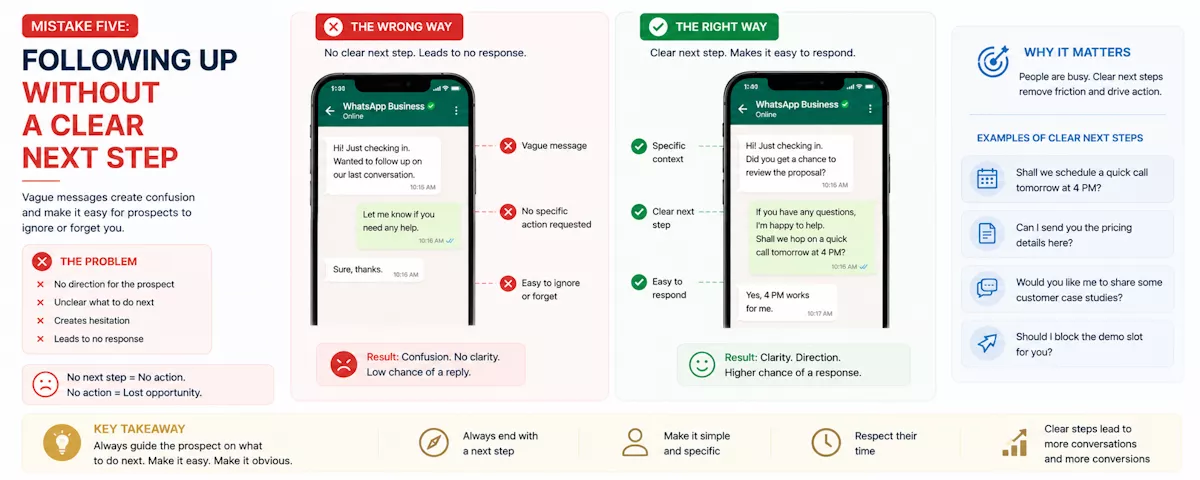
A follow-up message that says ‘Just checking in, let us know if you have any questions’ asks the prospect to do all the work of figuring out what to say next. Most will not bother. Vague follow-ups produce vague results — or no result at all.
Every follow-up message should give the prospect one specific, low-effort thing to do. ‘Reply YES if you would like me to hold your slot until Friday.’ ‘Type CALL and I will ring you this evening.’ ‘Reply 1 for pricing or 2 to see the product demo video.’ The prospect does not have to think about how to respond — the options are already laid out, and a reply takes seconds.
This is a template design discipline as much as a follow-up strategy. Every approved template used in a follow-up sequence should be built around a single, obvious action — never an open-ended invitation to respond if the prospect feels like it.
Mistake Six: Treating Every Lead With the Same Follow-Up Cadence
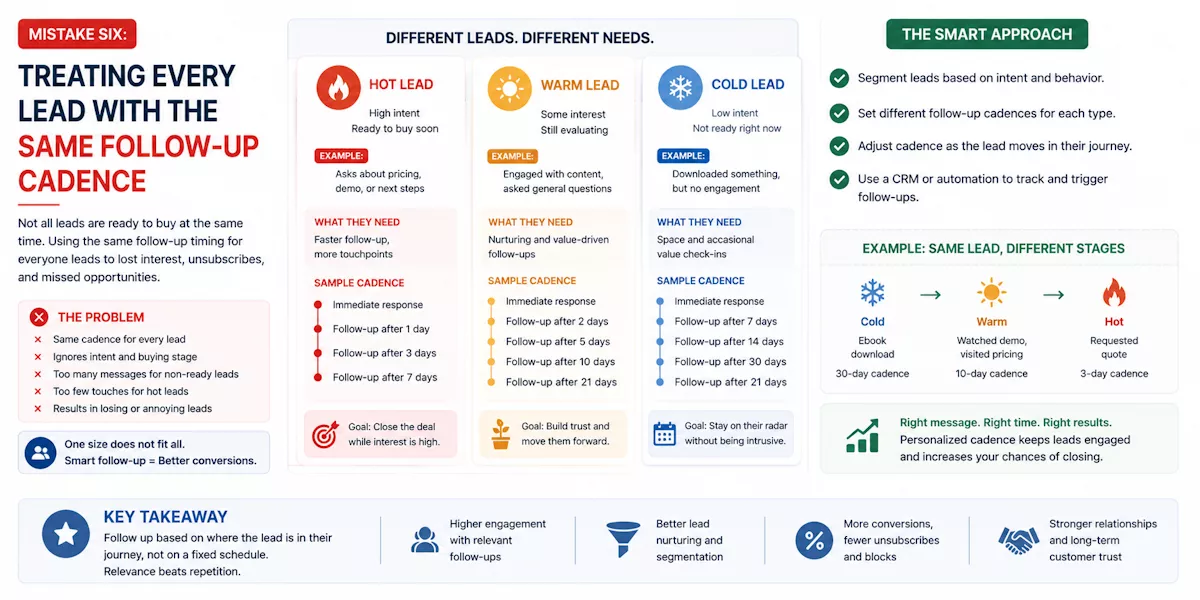
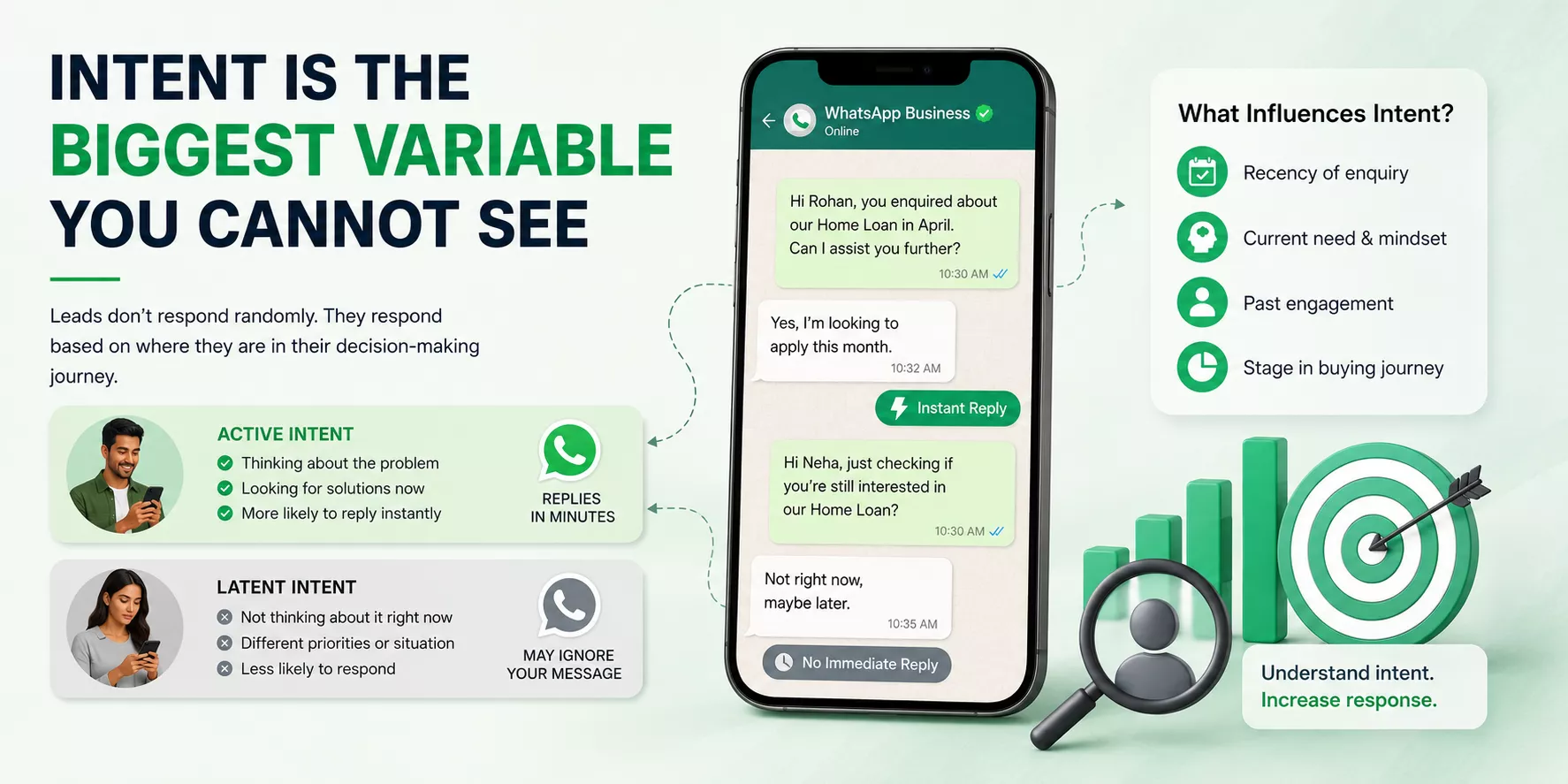
A high-intent lead who asked detailed pricing questions and a lead who casually enquired and went quiet do not deserve the same follow-up pace. Sending both the identical three-message sequence over the identical two weeks treats your hottest leads with the same urgency as your coldest ones, which means you are under-serving the leads most likely to convert.
High-intent signals — detailed questions, multiple messages in a single session, specific requests like pricing or availability — should trigger faster, more frequent follow-up. Lower-intent signals — a single brief enquiry, no further engagement — can sit in a slower, more spaced-out nurture sequence. Routing rules in a multi-agent inbox can flag high-intent conversations for priority handling, ensuring your best opportunities are not sitting in the same queue as casual browsers.
What Good Follow-Up Actually Requires
None of these mistakes happen because businesses do not care about their leads. They happen because follow-up on WhatsApp is being managed manually, reactively, and without a system designed for the channel’s specific demands — speed, relevance, continuity, and a clear next step every time.
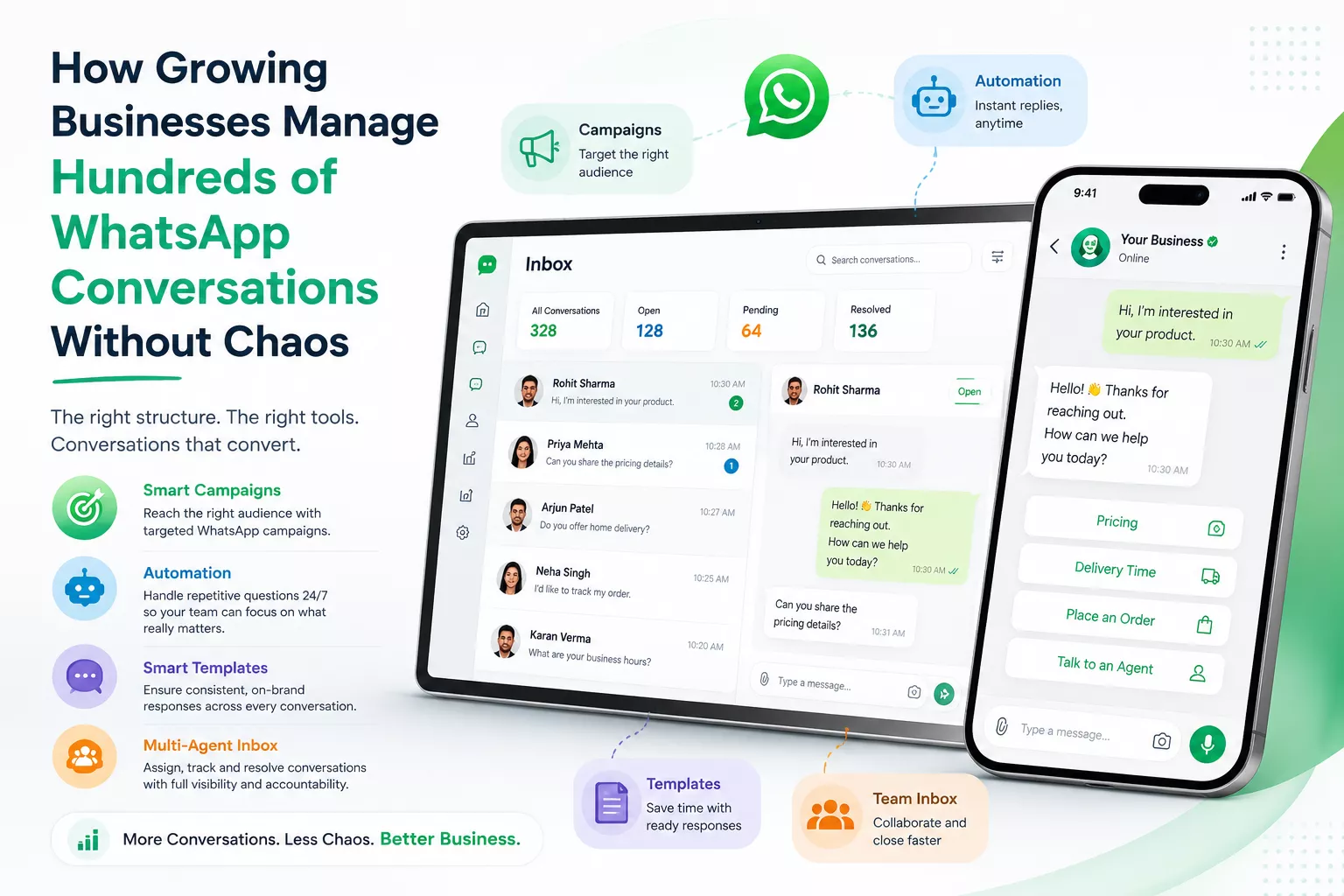
Fixing it requires the same four components working together: campaigns and templates that initiate contact with a planned, varied sequence rather than a single repeated message, automated replies that close the speed gap and preserve context, and a multi-agent inbox that tracks every conversation through to resolution rather than letting threads go silent unnoticed.
At 24/7 Marketing, we build follow-up systems with all of this designed in from the start — so the leads your campaigns generate do not get lost to slow responses, repeated messages, or conversations that quietly went cold because nobody was tracking them.
Stop losing leads to bad follow-up. Build a system that actually closes the loop. Visit 247marketing.in.