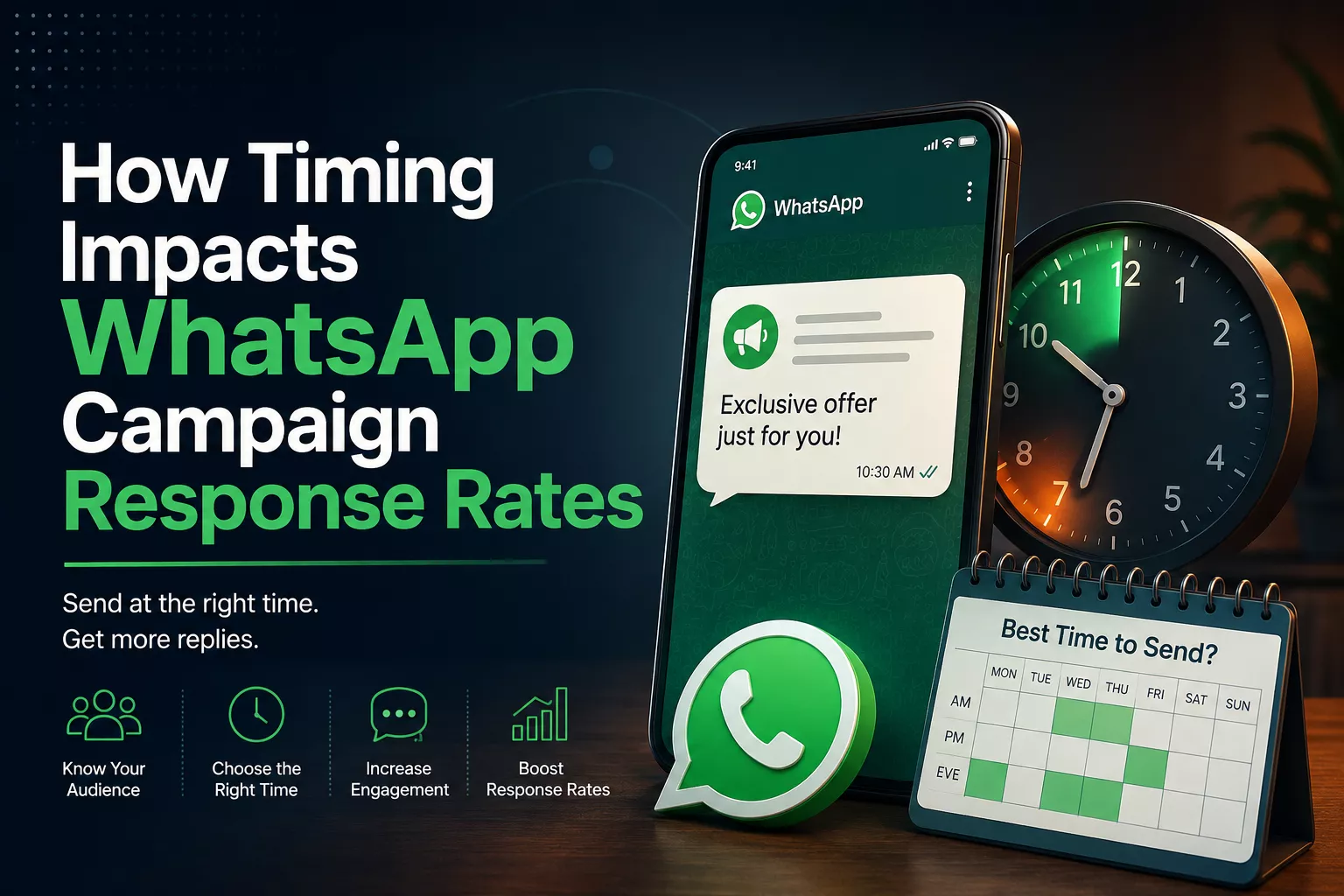
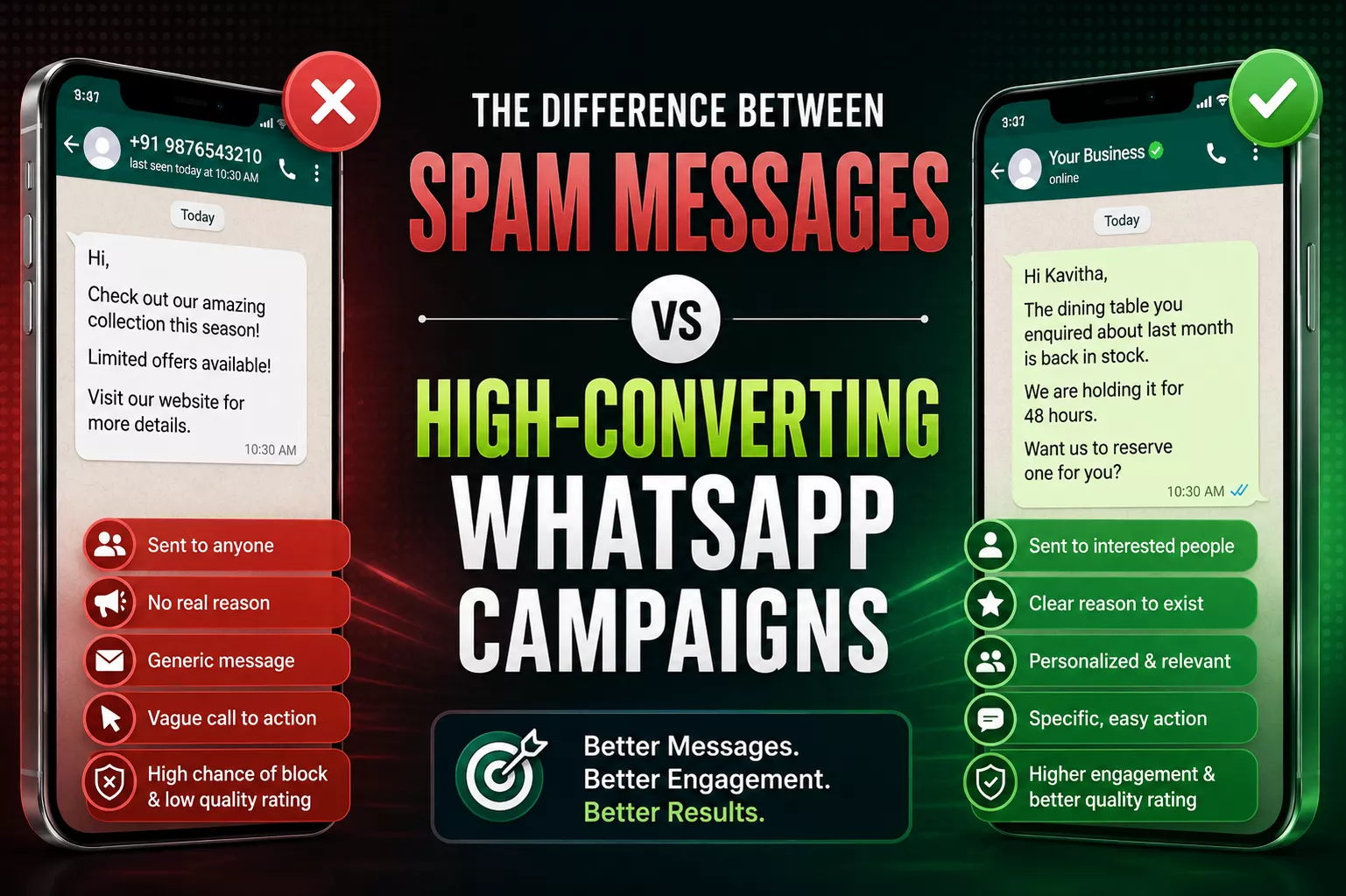
Same message. Same list. Same offer. Sent at two different times — and the response rates are completely different. This is not a theory. Businesses running repeated WhatsApp campaigns to similar audiences consistently find that send time produces measurable variance in replies, even when everything else stays identical.
Most businesses spend significant time writing campaign messages, segmenting lists, and getting templates approved — and then pick a send time based on when it is convenient for the person hitting the button. That is leaving conversion on the table. But here is what most timing guides do not say upfront: there is no universal best time to send a WhatsApp campaign. The right window depends entirely on who you are sending to — their daily routine, their profession, their lifestyle, and when they are actually in a headspace to engage with a business message.
What follows is not a fixed schedule. It is a framework for understanding how timing affects response — and how to find the right timing for your specific audience.
Why WhatsApp Timing Is Different From Email Timing
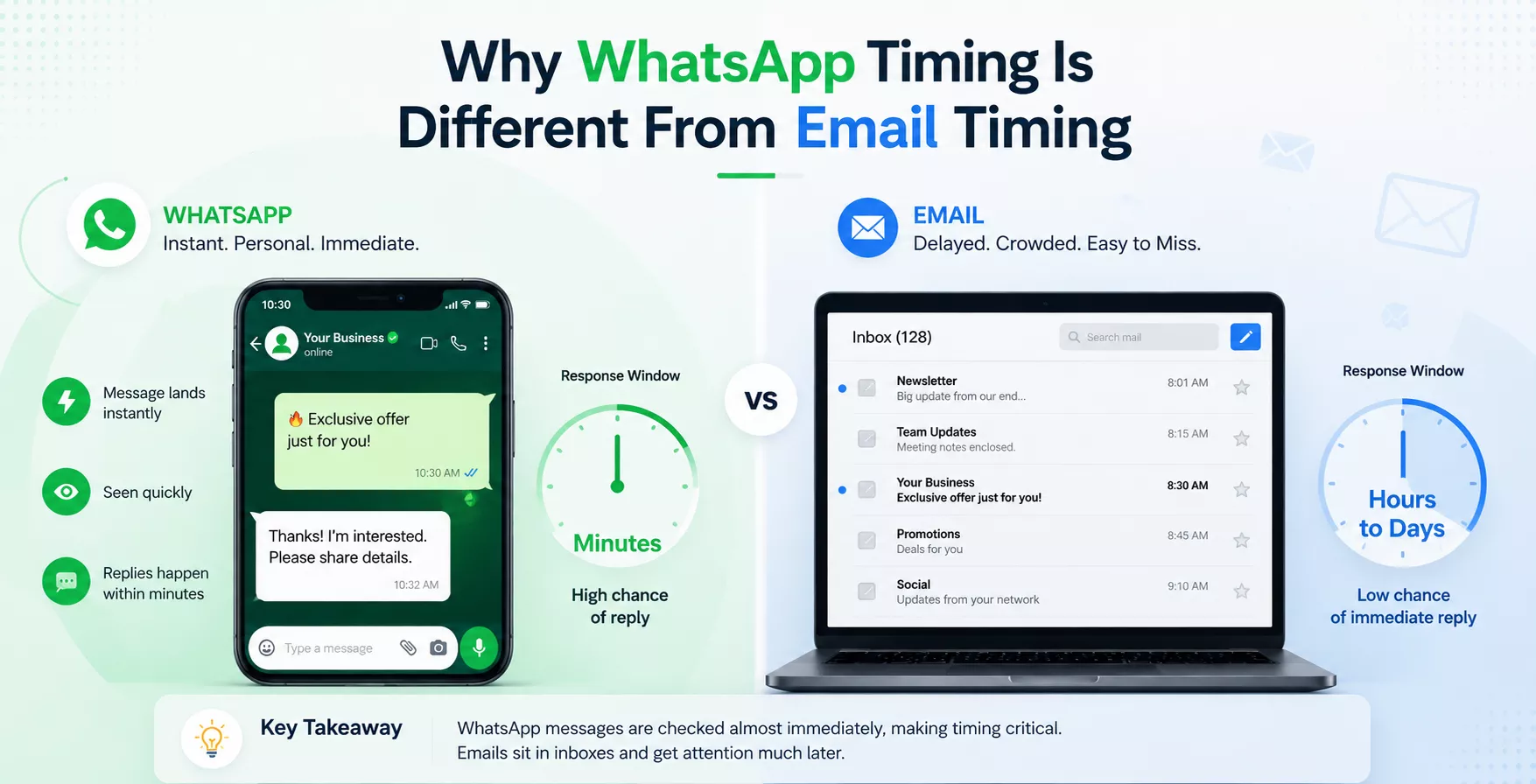
Email lands in an inbox that people sort through in batches. A message arriving at 8 AM might get read at 11 AM alongside seventeen others. The open window is long — sometimes days. WhatsApp notifications get checked almost immediately in most cases. The message lands and the recipient either engages within the next few minutes or the notification gets swiped away and joins the background noise of the day.
The response window on WhatsApp is short and front-loaded. This makes timing more consequential on this channel than almost any other. The question is not just when is the recipient likely to see the message — it is when is the recipient most likely to have the mental space and the motivation to reply. For a construction materials supplier, that moment looks nothing like it does for a fitness studio or a student coaching brand. The channel is the same. The audience is not.
Timing Windows That Often Underperform -- But Not Always
Monday mornings are often cited as poor send windows, and for many consumer-facing industries they are — people are clearing their weekend, catching up on priorities, and a business WhatsApp message competes with that mental load. But for an industry whose customers plan their week on Sunday night and are actively making decisions by 9 AM Monday, this assumption breaks down.
Friday afternoons tend to produce lower engagement across many audiences because decision-making slows before the weekend. But for a restaurant, a travel brand, or an entertainment business, Friday afternoon is exactly when their audience is planning what to do next — and a well-timed message lands in a highly receptive moment.
Late-night sends after 10 PM are risky for most audiences because the notification arrives when someone is winding down and feels intrusive. For some audiences — late-night shoppers, night-shift workers, students — those hours are peak phone time. The point is not that these windows are universally bad. The point is that they require you to know your audience well before you use them.
General Windows Worth Testing -- Depending on Your Audience
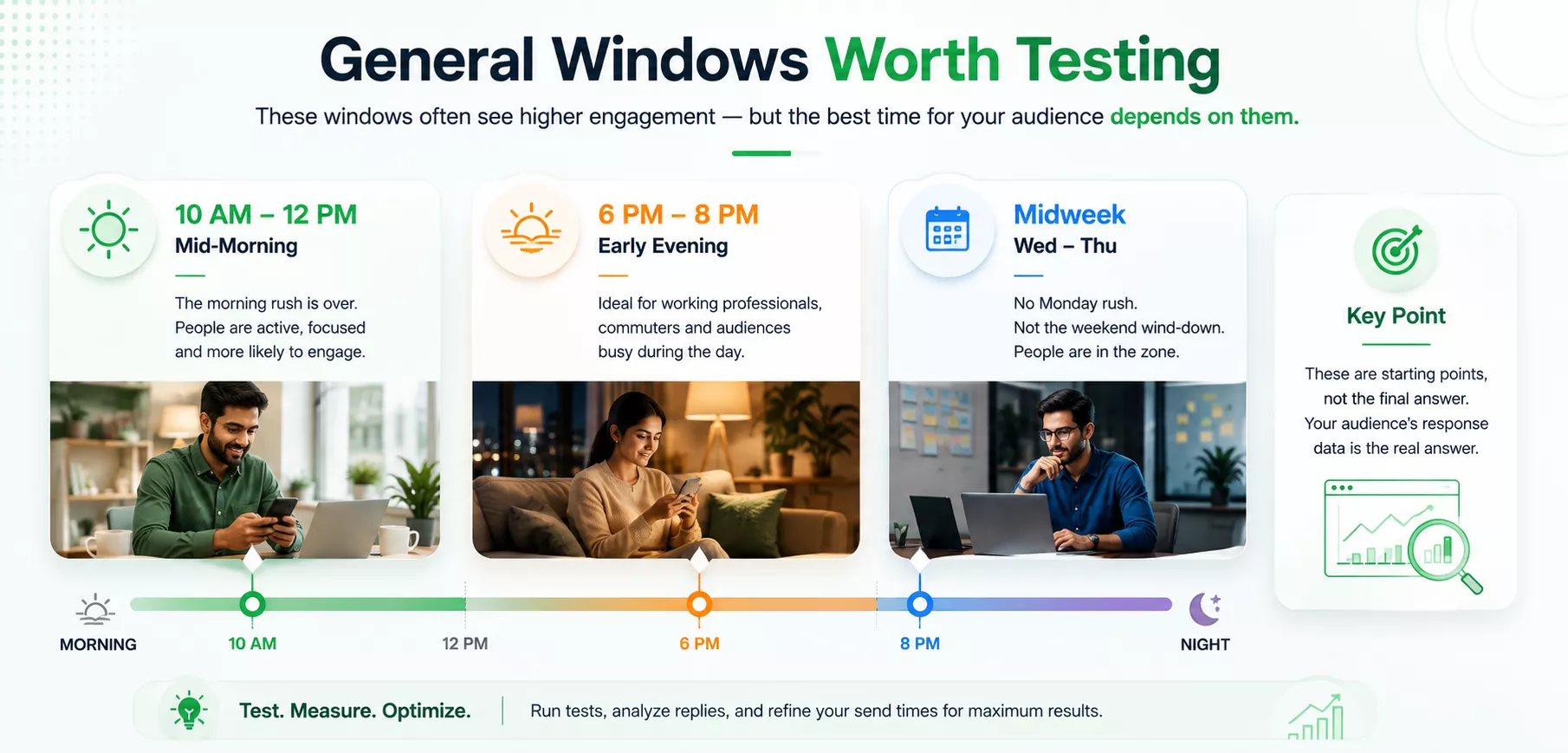
Mid-morning on weekdays — roughly 10 AM to 12 PM — tends to work well across a broad range of audiences because the morning rush has settled and people are in an active, responsive state. It is not a guarantee, but it is often a good starting point for a first test if you have no prior data on your audience’s behaviour.
Early evenings — 6 PM to 8 PM — produce strong engagement for audiences that are unreachable or distracted during standard business hours: working professionals, commuters, people with active daytime schedules. Whether this window applies to your audience depends on whether your customers fall into this category or whether they are available and attentive during the day.
Midweek days — Wednesday and Thursday — tend to outperform the start and end of the week for many audiences because there is no competing mental context: neither Monday’s re-entry into the week nor the wind-down toward the weekend. But again, this depends on the industry. A weekend-focused business may find Sunday evening outperforms any weekday.
These are starting points for testing. They are not the answer. Your audience’s response data is the answer.
How Different Audiences Actually Behave - and Why It Matters More Than Any General Rule
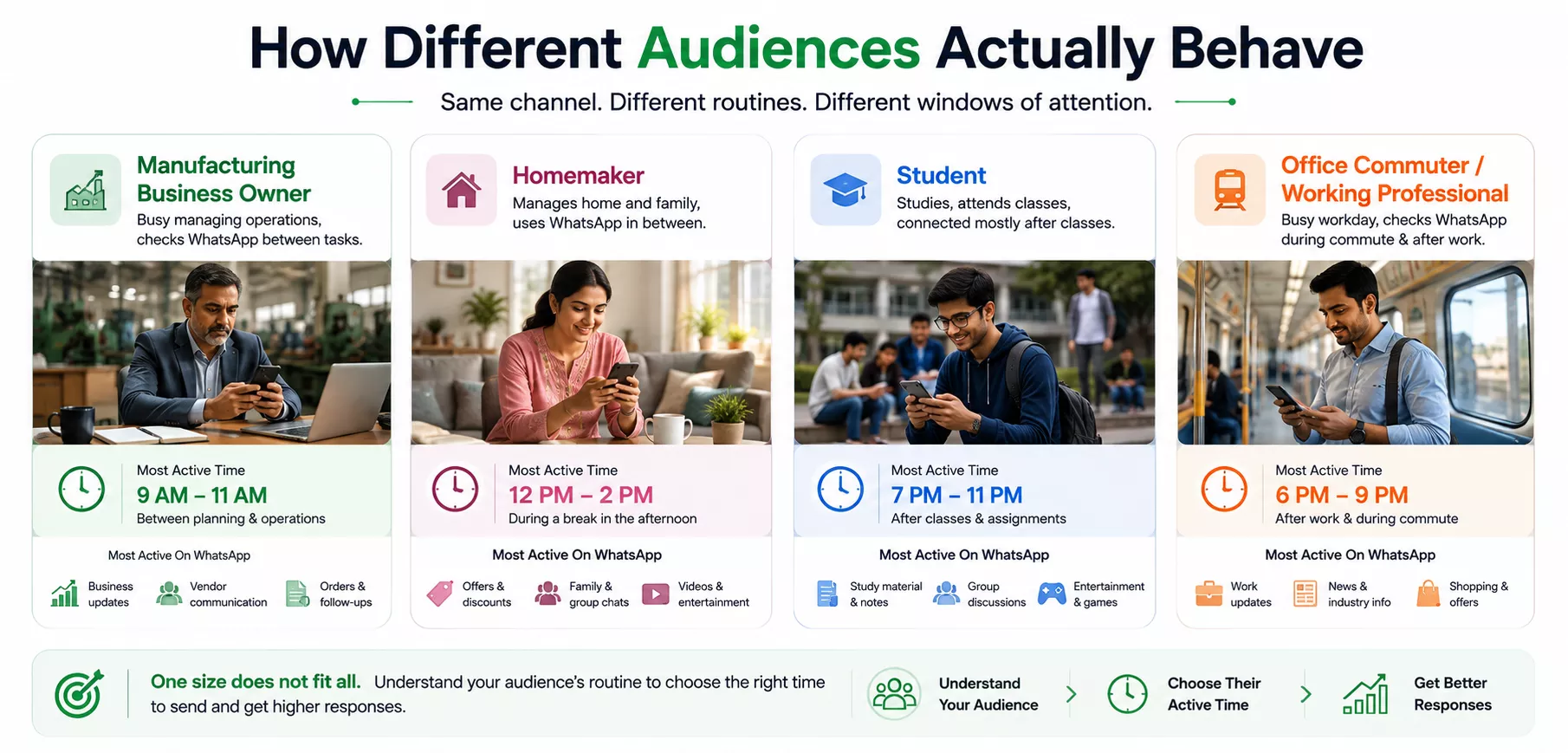
A business owner who runs a manufacturing unit is not on WhatsApp in the same way as a college student or a homemaker. Their routine, their phone habits, and their decision-making windows are completely different. Treating them with the same send time assumes they are interchangeable, which they are not.
The manufacturing business owner may be most reachable and responsive early morning before the factory floor demands their attention, or late evening after operational decisions for the day are done. A homemaker’s day has a completely different rhythm — their available, responsive window sits in a different part of the morning. A student’s peak WhatsApp hours skew later in the day and are concentrated on evenings and weekends. A metro commuter checks their phone intensively during travel windows that most businesses do not factor into their campaign scheduling at all.
None of these patterns are universal within their category either. A homemaker in a metro city and a homemaker in a smaller town may have different routines, different phone habits, and different windows. Industry experience and audience observation matter more than any published timing benchmark.
The only timing guide worth following for your business is the one built from your own data — not from a blog post, not from email marketing benchmarks applied to WhatsApp, and not from what worked for a different industry with a different customer profile.
How to Actually Find Your Audience's Best Timing
Run the same campaign to two equal segments of your list at two different times. Keep the message identical. Track replies within the first two hours — not total replies across the whole day, but the immediate two-hour window which reflects genuine in-the-moment engagement. After three or four experiments across different times and days, patterns emerge that are specific to your audience.
Also look at when inbound messages arrive from customers outside of campaign sends. If a significant share of your WhatsApp enquiries consistently arrive between 8 PM and 10 PM, that is your audience telling you when they are active — not because of your campaign timing, but because that is simply when they use WhatsApp for decisions. That data should directly influence when you schedule your next campaign.
Two or three rounds of this testing tells you more about the right send window for your specific audience than any general timing framework. Stop borrowing timing assumptions from industries whose audiences bear no resemblance to yours.
Timing Without the Infrastructure to Handle Replies Is a Half-Strategy
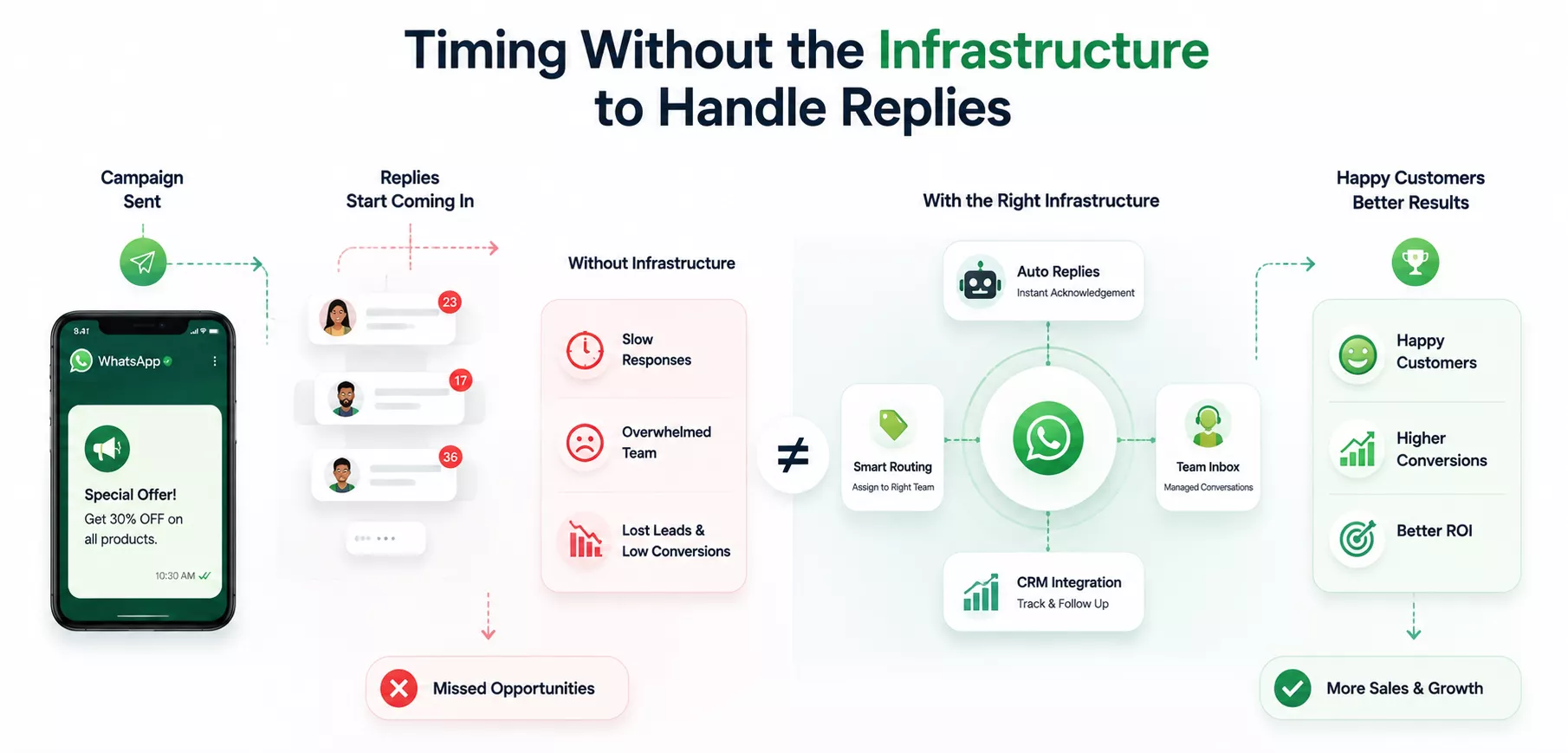
Finding the right send time generates a spike of replies in a compressed window. If your team is not equipped to handle that spike at the time it arrives — because the campaign was scheduled for 7 PM and your support team finishes at 6 PM — the timing advantage is wasted. You reached people at their ideal moment and then made them wait.
This is why automated reply flows are a core part of campaign timing strategy, not a separate support function. When a campaign is scheduled for an evening window because your audience data says that is when they respond, the automated replies covering that window need to be active and ready at the same time. Approved templates need to be built in advance. The multi-agent inbox needs to be configured so the overnight replies are organised and prioritised for the team when they log in the next morning.
The best timing in the world for your specific audience still fails if the system behind the campaign cannot match the pace of responses it generates. Getting both right — the send time and the reply infrastructure — is what the difference in response rate actually reflects.
At 24/7 Marketing, campaign timing is treated as part of the full setup — alongside contact segmentation, approved templates, and automated reply flows — because a well-timed campaign that hits your audience at the right moment and is met with an immediate, relevant response converts at a fundamentally different rate than one that timed well but left people waiting.
Want campaigns timed around your audience, not a generic schedule? Visit 247marketing.in.