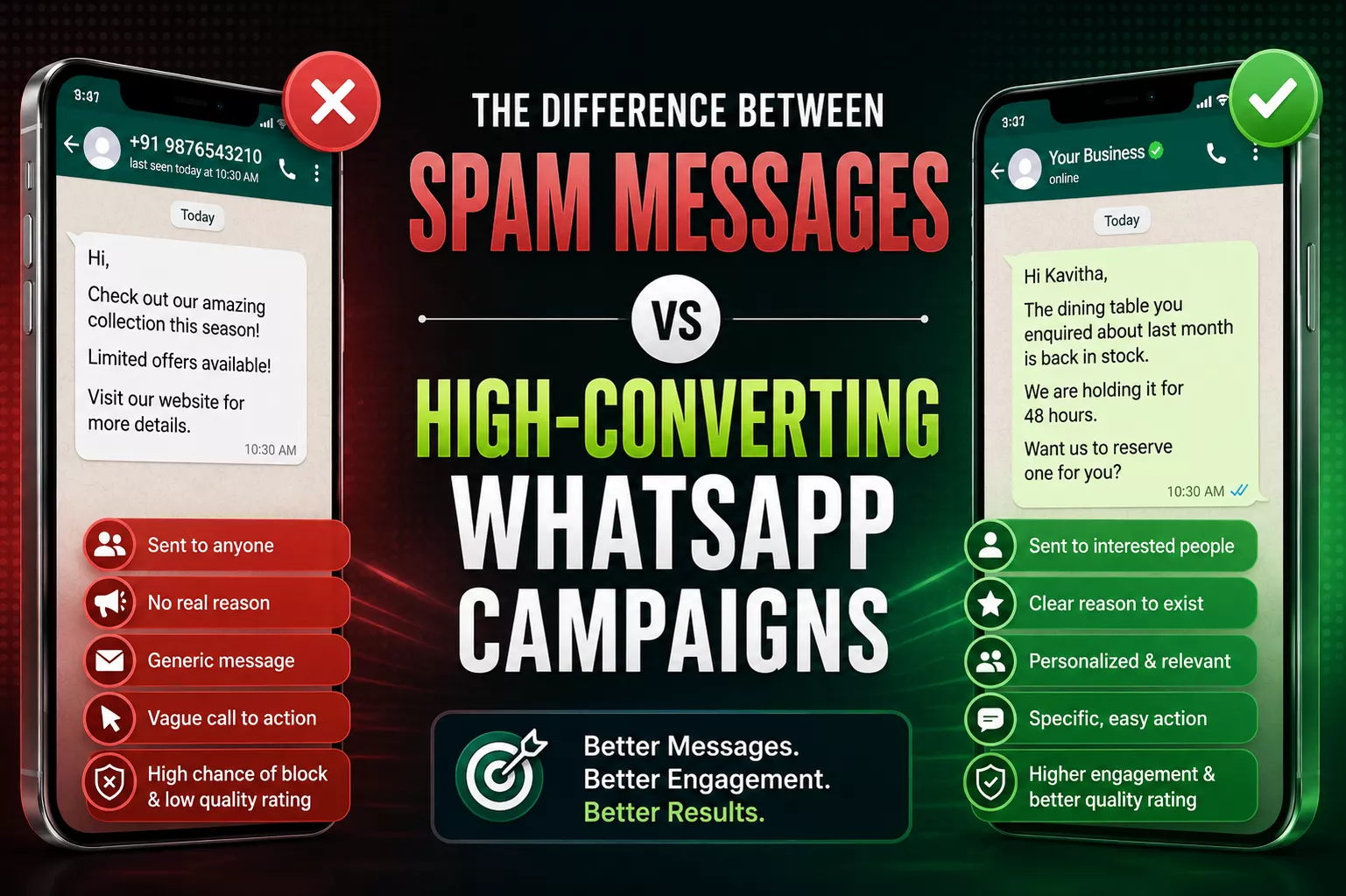
When a business has 50 WhatsApp conversations a month, manual follow-up works fine. One person, sometimes the founder, knows every lead by name, remembers what each one asked, and replies personally to everyone. It feels efficient because, at that volume, it is.
Then the business grows. The same approach that worked at 50 conversations a month gets applied at 500, then 1,500. Nobody made a conscious decision to keep doing it manually — it is just the system that was already in place, and changing it felt like a project for later. Later arrives when leads start slipping through, response times stretch from minutes to days, and the team that used to feel on top of things now feels permanently behind.
Manual WhatsApp follow-up does not fail because the people doing it are careless. It fails because it was never designed to scale, and growth exposes that design flaw whether or not anyone planned for it.
The Math That Breaks Quietly
A single person managing WhatsApp follow-up can realistically handle meaningful, attentive conversations with maybe 30 to 40 leads a day before quality starts dropping. Beyond that, something gives — response times slow down, messages get shorter and less personalised, or some leads simply do not get a response at all because there were not enough hours.
A business running a successful WhatsApp campaign that generates 200 replies in a single day has already blown past what one person can manage well. The instinct is to add a second person, then a third. But adding people to a manual process does not fix the structural problem — it just delays the point at which the same breakdown happens at a higher number. Without a system, ten people following up manually run into the exact same coordination failures that two people did, just at greater scale and cost.
Symptom One: Leads Get Followed Up Twice or Not at All
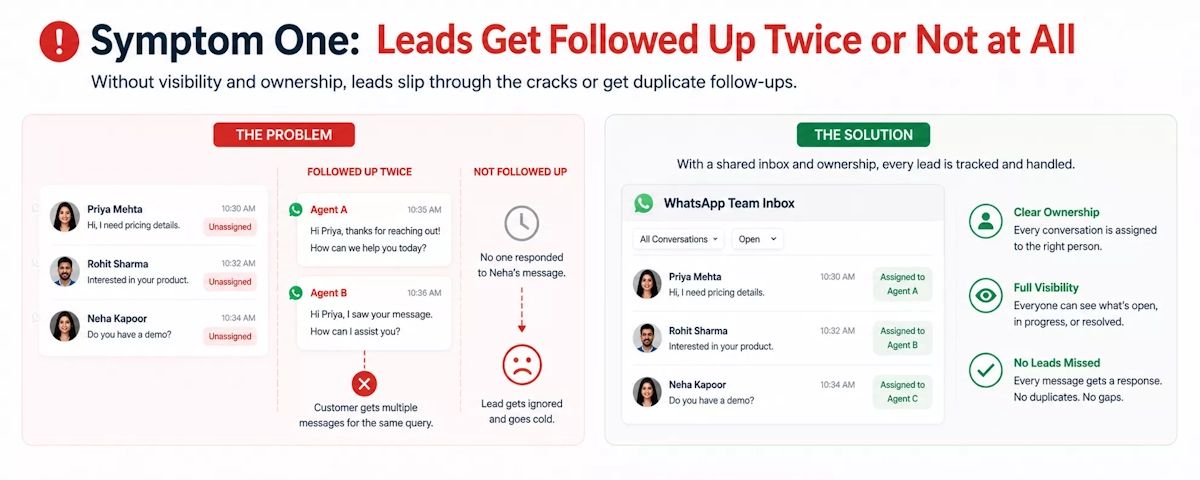
Without a shared system tracking who owns which conversation, two team members can end up messaging the same prospect within the same hour, asking the same question. The prospect notices. It looks disorganised, and it often is. On the other side of the same problem, leads that nobody explicitly claimed sit untouched because everyone assumed someone else was handling it.
This is not a discipline problem that better instructions can fix. It is a visibility problem. When WhatsApp conversations are spread across personal devices or a single shared phone with no structure, there is no way for a team to see, at a glance, what has been handled and what has not. The team is working blind, and blind coordination breaks down predictably as headcount and volume increase.
Symptom Two: Response Quality Becomes Inconsistent
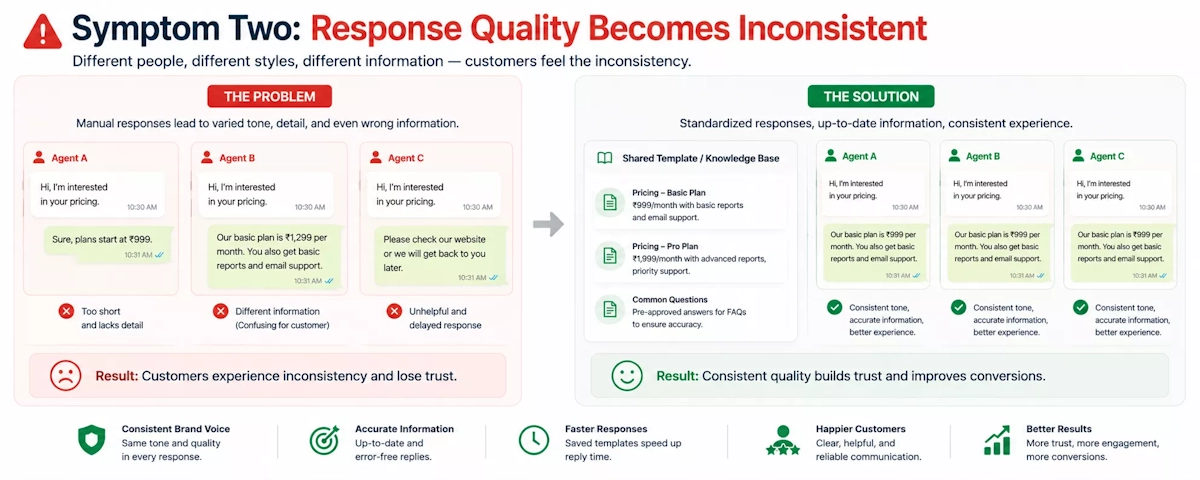
In a small operation, the founder or a single trained person handles every conversation with the same tone, the same accuracy, and the same attention to detail. As the team grows, that consistency is the first thing to erode. One agent writes detailed, warm responses. Another, under time pressure, sends three-word replies. A third occasionally gives outdated pricing because they were not updated on a recent change.
Customers experience this as inconsistency in the brand itself, not as a staffing issue. A prospect who gets a sharp, helpful reply on Monday and a vague, delayed one on Thursday does not conclude that two different people handled their enquiries. They conclude that the business is unreliable. Manual processes have no mechanism to enforce consistency once more than one or two people are involved.
Symptom Three: Follow-Up Sequences Exist Only in Someone's Head
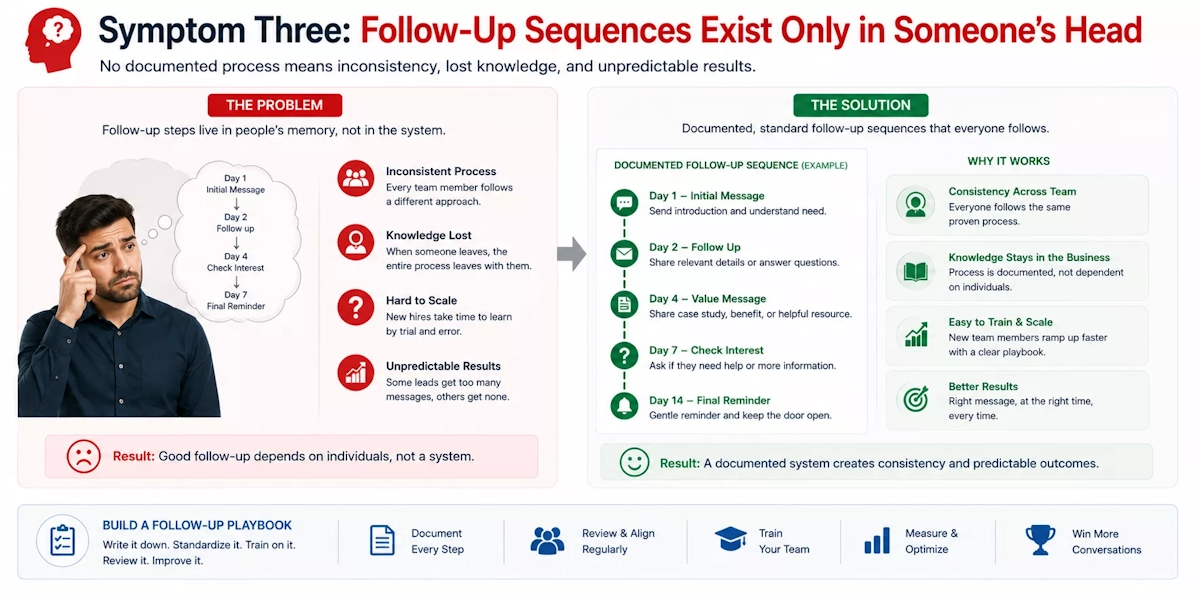
In a manual setup, the follow-up cadence — when to send a second message, what to say if the first one is ignored, how long to wait before considering a lead cold — usually lives in the experience and memory of whoever has been doing it longest. It is not written down. It is not consistent across the team. New hires follow up differently than experienced staff, simply because nobody formalised what ‘good follow-up’ actually looks like.
This becomes a serious liability as the team grows or as people leave. A staff member who was excellent at follow-up takes that process knowledge with them when they exit. The business has no documented, repeatable system — just a set of individual habits that varied from person to person and were never captured anywhere a new hire could learn from.
Symptom Four: Campaign Volume Outpaces Reply Capacity
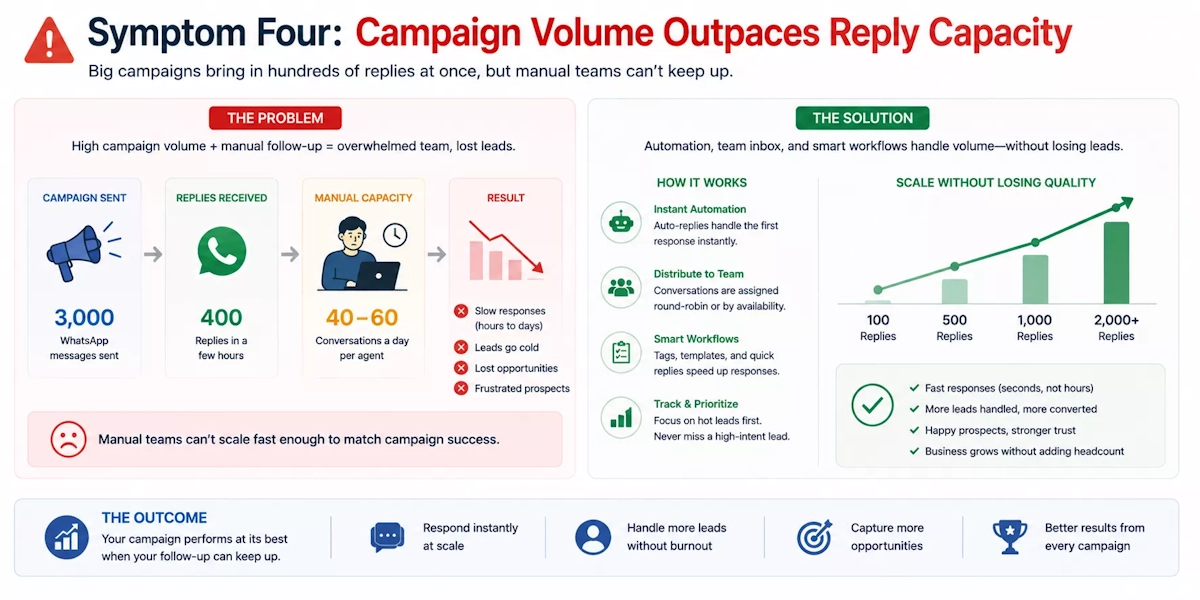
This is where the limits of manual follow-up become most visible. A business runs a WhatsApp campaign to 3,000 contacts because the marketing team, correctly, recognises that WhatsApp gets exceptional engagement. The campaign performs well — 400 people reply within a few hours. Now the team that was managing follow-up manually has to handle 400 conversations on top of their existing workload, all arriving in a compressed window.
Manual capacity simply cannot absorb a spike like this. Either the campaign gets scaled back to a volume the team can manually handle — which limits growth and wastes the channel’s real potential — or the campaign goes out at full scale and the support team drowns, response times collapse, and a chunk of the engagement the campaign generated is wasted because nobody got to it in time.
Neither outcome is acceptable for a business trying to grow. The campaign and the follow-up capacity need to scale together, and manual processes cannot stretch fast enough to match a successful campaign’s results.
What Replaces Manual Follow-Up Without Losing the Personal Feel
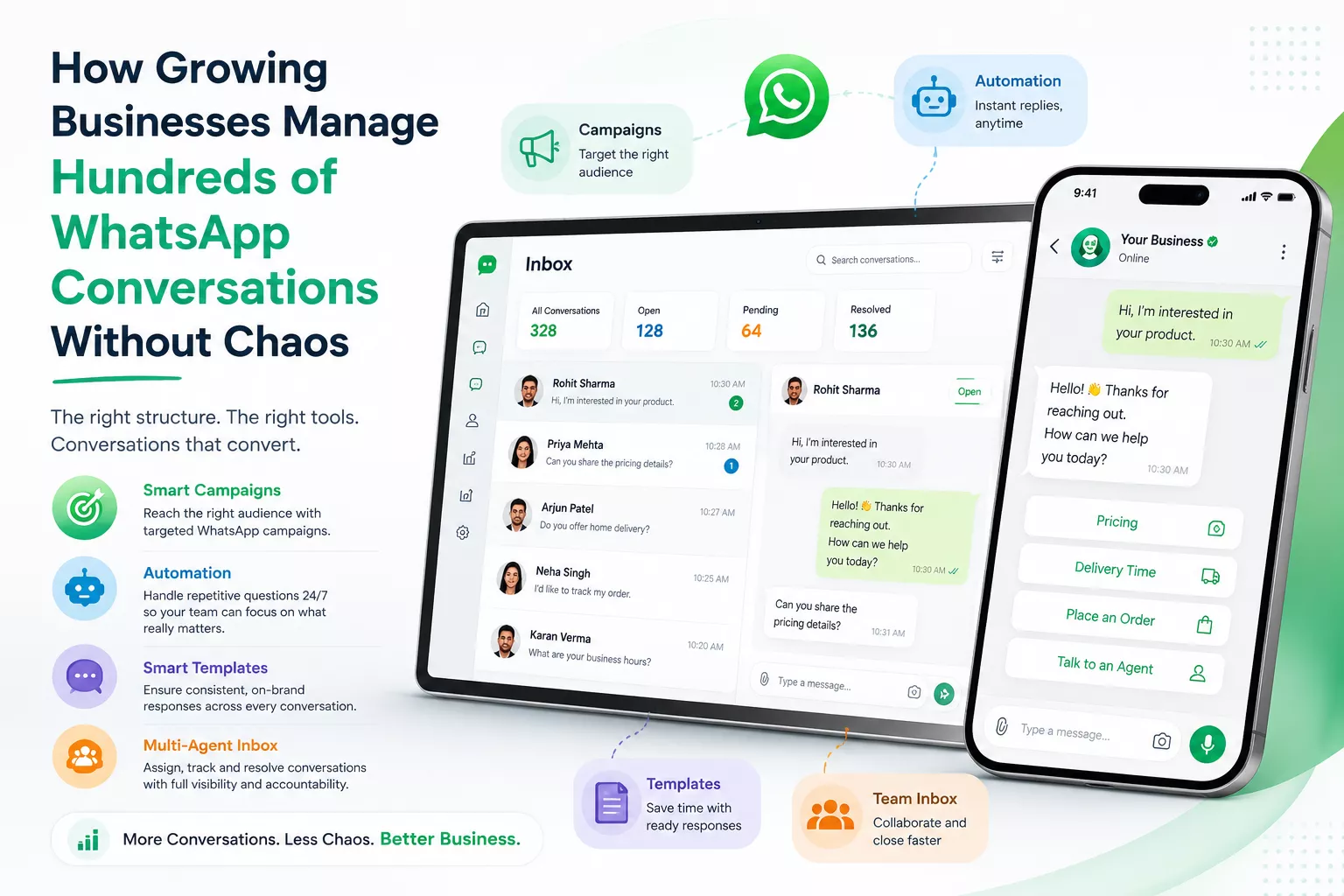
The instinct many businesses have is that automation will make their WhatsApp presence feel impersonal — which is a reasonable concern, but not an accurate prediction of what a properly built system actually produces. Automated reply flows handle the repetitive, predictable parts of follow-up — acknowledging a message instantly, asking qualifying questions, sharing information that does not vary person to person. This is not where the personal touch was coming from in the first place. The personal touch was in the judgment calls, not in typing the same pricing answer for the fortieth time.
Approved WhatsApp templates ensure that even at scale, every customer gets a consistent, accurate, well-written message — removing the variance that comes from one agent being more careful than another. The template was written once, reviewed, approved, and now every send carries that same quality, regardless of who triggers it or how busy the team is that day.
And a multi-agent inbox replaces the guesswork of manual coordination with structure. Every conversation has a visible owner. Nothing gets double-handled or missed because there is no system tracking it. Supervisors can see the full picture of what is happening across the team in real time, instead of relying on people to remember and report status manually.
The Transition Point Most Businesses Miss
There is rarely a single dramatic moment where manual follow-up obviously stops working. It degrades gradually — a slightly slower response here, a missed lead there, an inconsistent message that goes unnoticed individually but compounds across hundreds of interactions a month. By the time the problem becomes visible in lost revenue or customer complaints, the business has often been operating below its potential for months.
The right time to move from manual to systemised WhatsApp follow-up is before the breaking point, not after. A reasonable signal: if your team is spending more time managing WhatsApp logistics — who replied to whom, who is following up on what — than actually having productive sales or support conversations, the system has already outgrown the manual process, even if nobody has said it out loud yet.
Businesses that build campaigns, templates, automated replies, and a multi-agent inbox into one connected system do not lose the personal quality that made WhatsApp work for them in the first place. They scale that quality across every conversation, instead of letting it apply only to the lucky leads who happened to reach the right person on the right day.
At 24/7 Marketing, we help businesses make this transition before growth turns into chaos — building the infrastructure that lets WhatsApp follow-up keep its personal quality while operating at a volume no single person, or even a small team, could manage by hand.
Outgrowing manual WhatsApp follow-up? Build a system that scales with you. Visit 247marketing.in.