At some point in every customer relationship, the conversation goes quiet. Not because the customer decided they were done — usually because life got busy, the timing felt wrong, or the last message did not give them a clear enough reason to respond. The thread sits there. The business does not follow up because it is unclear whether following up is appropriate. The customer does not reach out because they are waiting for something to prompt them. Both sides are waiting for the other to move.
This pattern plays out constantly on WhatsApp. A lead had three or four exchanges with your team, seemed genuinely interested, and then stopped responding mid-conversation. An existing customer placed an order, got support for an issue, and has not been back in four months. A prospect who enquired last quarter went dark after receiving a quote. Each of these is a relationship that has not ended — it has just stalled.
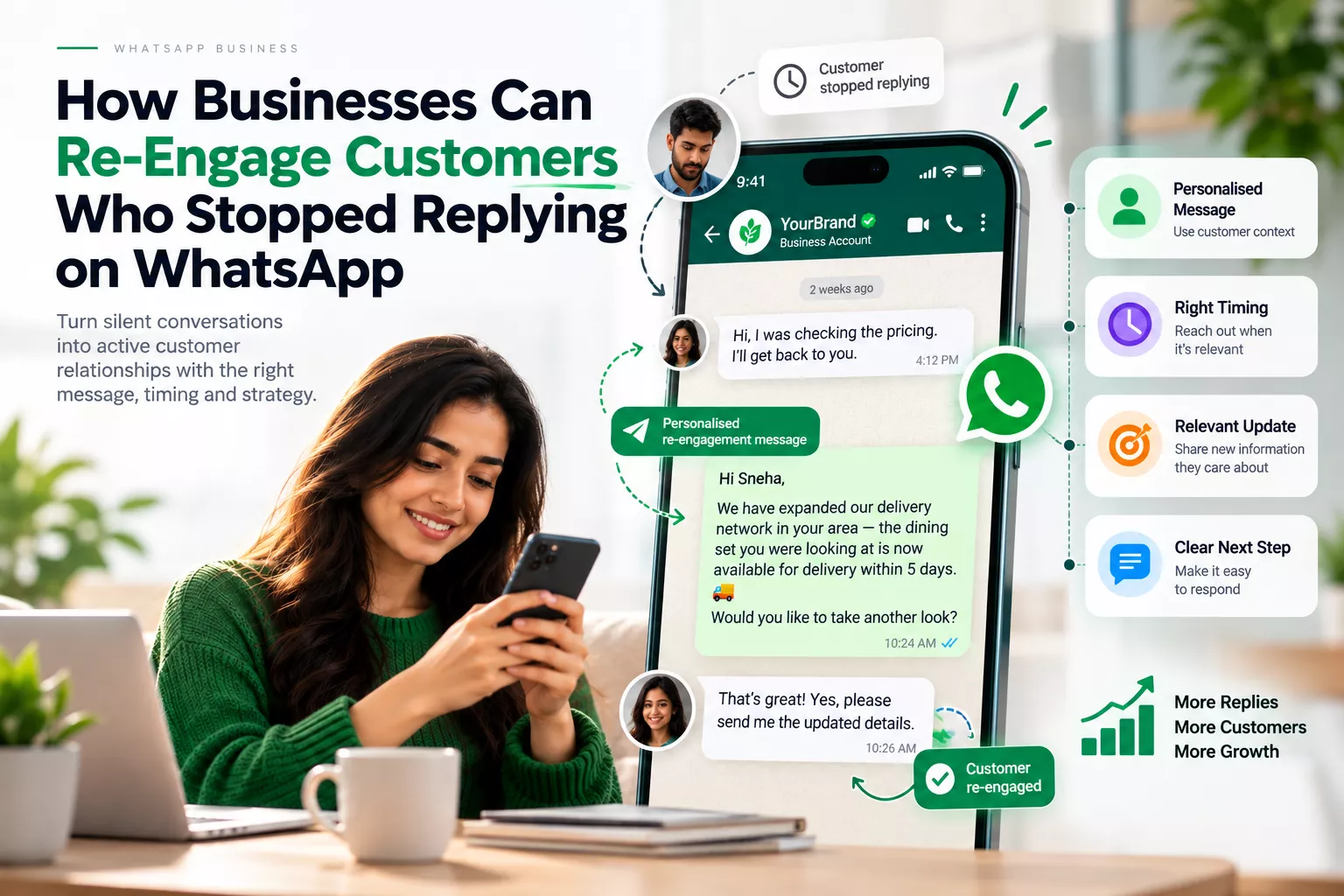
Re-engaging these contacts is not about sending more messages. It is about sending the right message at the right time with a structure that makes it easy for them to respond — and a system that handles what comes next the moment they do.
Why Customers Stop Replying -- and Why Most of Them Are Still Reachable
Businesses tend to interpret silence as rejection. In most cases it is not. The majority of customers who stop replying on WhatsApp fall into one of three categories: they got distracted and never came back to a conversation they intended to continue, the timing of the last interaction was off and the need has not yet become urgent again, or the last message they received did not give them a clear next step so they let it sit.
A much smaller proportion have genuinely moved on — bought elsewhere, changed their mind, or had their situation change in a way that made your product or service irrelevant. The problem is that businesses treat the entire silent segment as if they all fall into this smaller group and stop following up across the board.
WhatsApp is an unusually good channel for re-engagement precisely because the barrier to responding is so low. A short, relevant message that lands at the right moment gets a reply from contacts who would never have opened a re-engagement email or answered a re-engagement phone call. The channel does not feel like marketing. It feels like a message — and people reply to messages.
The First Rule: Do Not Send the Same Message That Already Failed
When a conversation goes quiet, the instinct is often to resend or restate the last message — a reminder, a follow-up, a nudge that is essentially the same pitch reworded. This almost never works, and often makes things worse. If the original message did not prompt a reply, sending a version of it again tells the contact that the business has not thought about why they did not respond.
Effective re-engagement starts from a different angle. What has changed since the last exchange? Has there been a new development in the product that is relevant to what this customer asked about? Has a relevant result from another customer emerged that speaks directly to the concern this contact expressed? Has the price, timeline, or availability changed in a way that removes an objection they might have had?
A furniture retailer whose customer enquired about a dining set and went quiet after seeing the delivery timeline sends a re-engagement message three weeks later: ‘Hi Sneha, we have expanded our delivery network in your area — the dining set you were looking at is now available for delivery within 5 days. Want to take another look?’ That is a different message from the original one because it addresses the thing that likely caused the silence.
Segmenting by How Long Ago the Silence Started
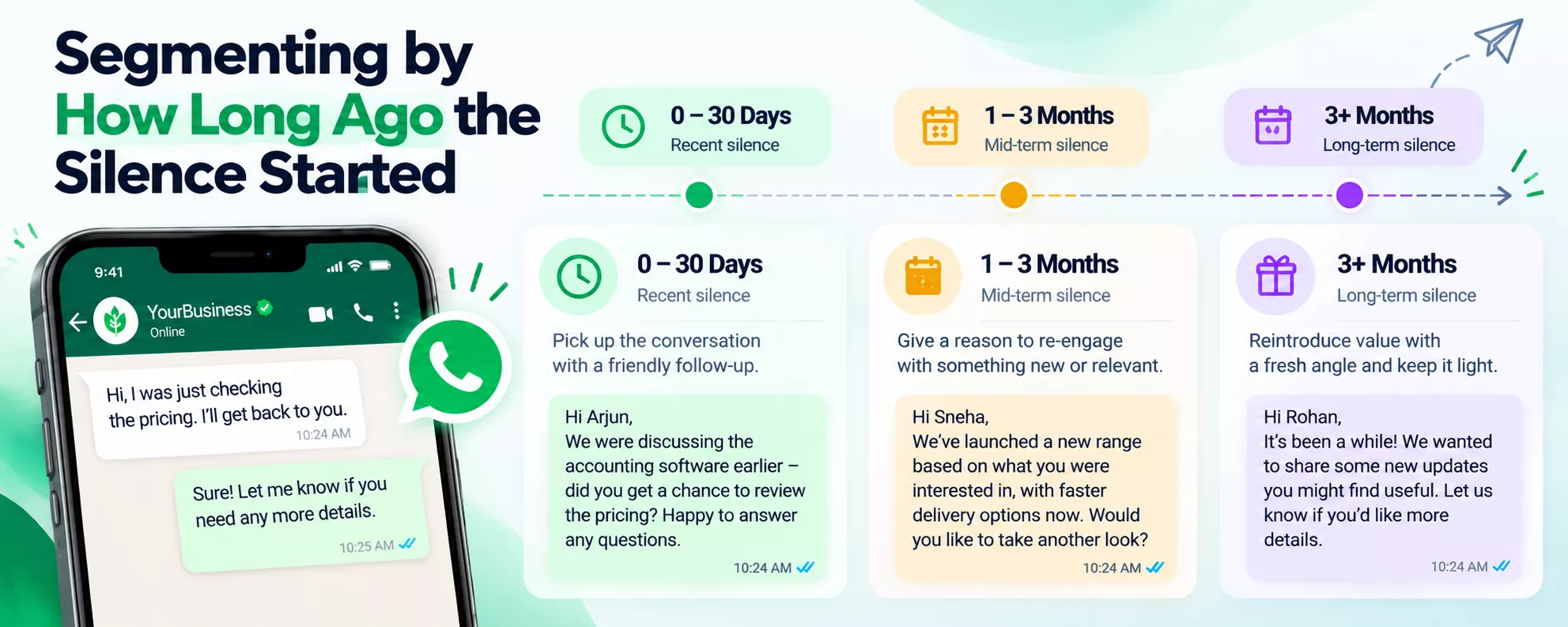
Not all silent contacts are the same. A customer who stopped responding two weeks ago is in a different place from one who last engaged four months ago. Treating them identically with one re-engagement campaign is a missed opportunity at best and a list-burndown risk at worst.
Contacts who went quiet within the last 30 days are closest to the original interest. A brief, direct message that picks up where the conversation left off works here. ‘Hi Arjun, we were discussing the accounting software earlier — did you get a chance to review the pricing? Happy to answer any questions you had.’ The tone is casual and specific. It does not feel like a campaign.
Contacts who went quiet between one and three months ago need a reason to re-engage that acknowledges the gap without drawing attention to it. A new feature, a seasonal relevance, a useful piece of information related to what they originally asked about — something that gives them a fresh entry point rather than asking them to remember a conversation they mentally closed weeks ago.
Contacts beyond three months need the gentlest approach. A useful piece of content — a guide, an industry update, a case study — with no sales ask attached. The goal is a reply, not a conversion. Once there is a reply, the conversation can develop from that point. Asking for a sale from a contact who has not engaged in four months skips several steps.
How Approved Templates Carry the Re-Engagement Strategy
Re-engagement messages sent through the WhatsApp Business API — reaching out to contacts outside an active 24-hour conversation window — require approved templates. This is not an obstacle. It is the mechanism that ensures re-engagement messages are specific, clear, and worth sending.
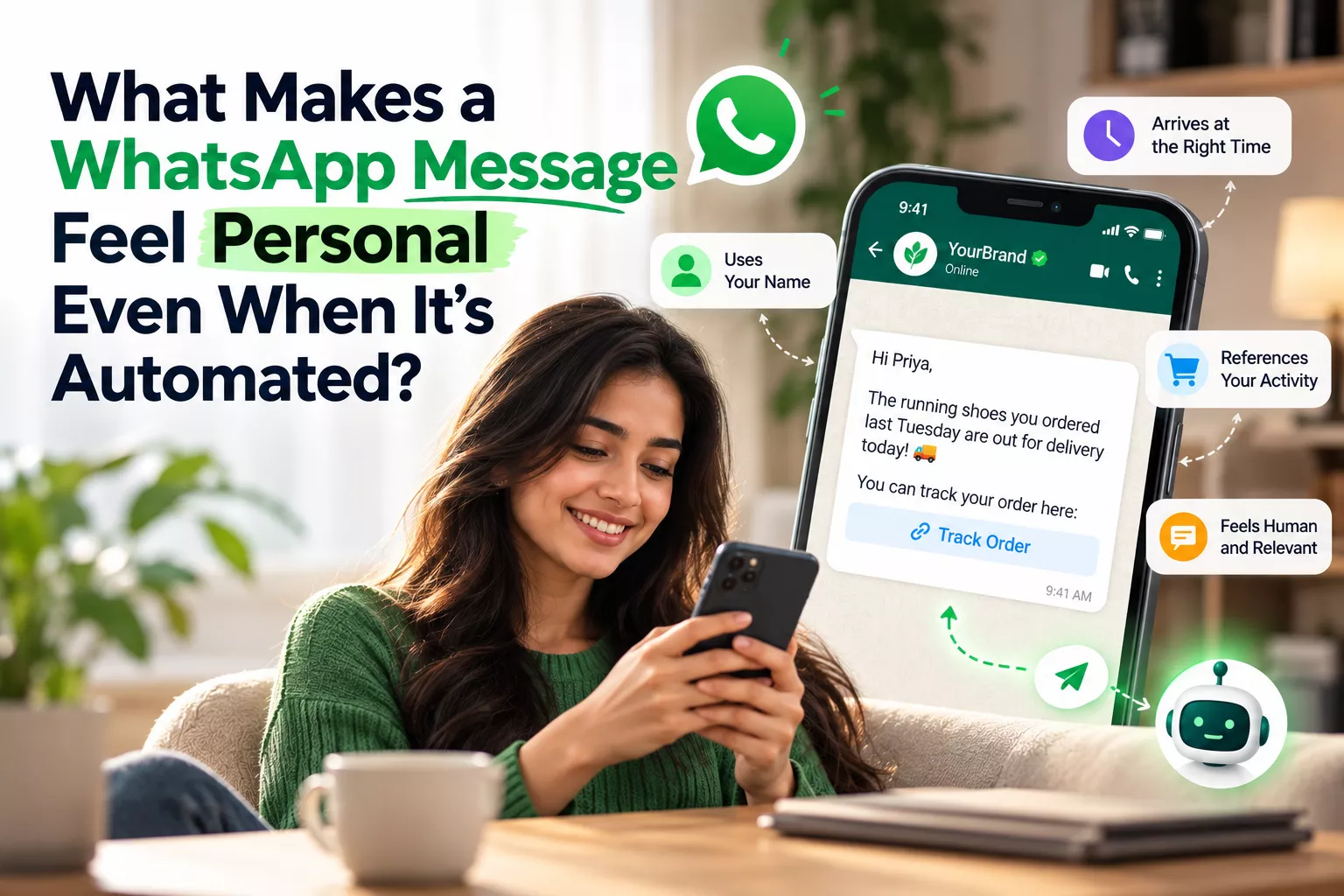
Templates for re-engagement need to be built per segment. A template designed for a 30-day lapse reads differently from one designed for a four-month lapse. Each uses dynamic variables to pull in the contact’s name, the product or service they enquired about, and any contextual detail that makes the message feel personal rather than broadcast. The template is approved once and then deployed to the relevant segment with personalised fields injected at send time.
At 24/7 Marketing, re-engagement templates are built as part of the campaign setup rather than as an afterthought. Three to four templates covering different lapse periods and different angles — a product update, a testimonial, a content offer, a direct check-in — are prepared and approved before the first re-engagement send. The sequence is planned in full before any of it goes out.
What Automation Does the Moment a Lapsed Contact Replies
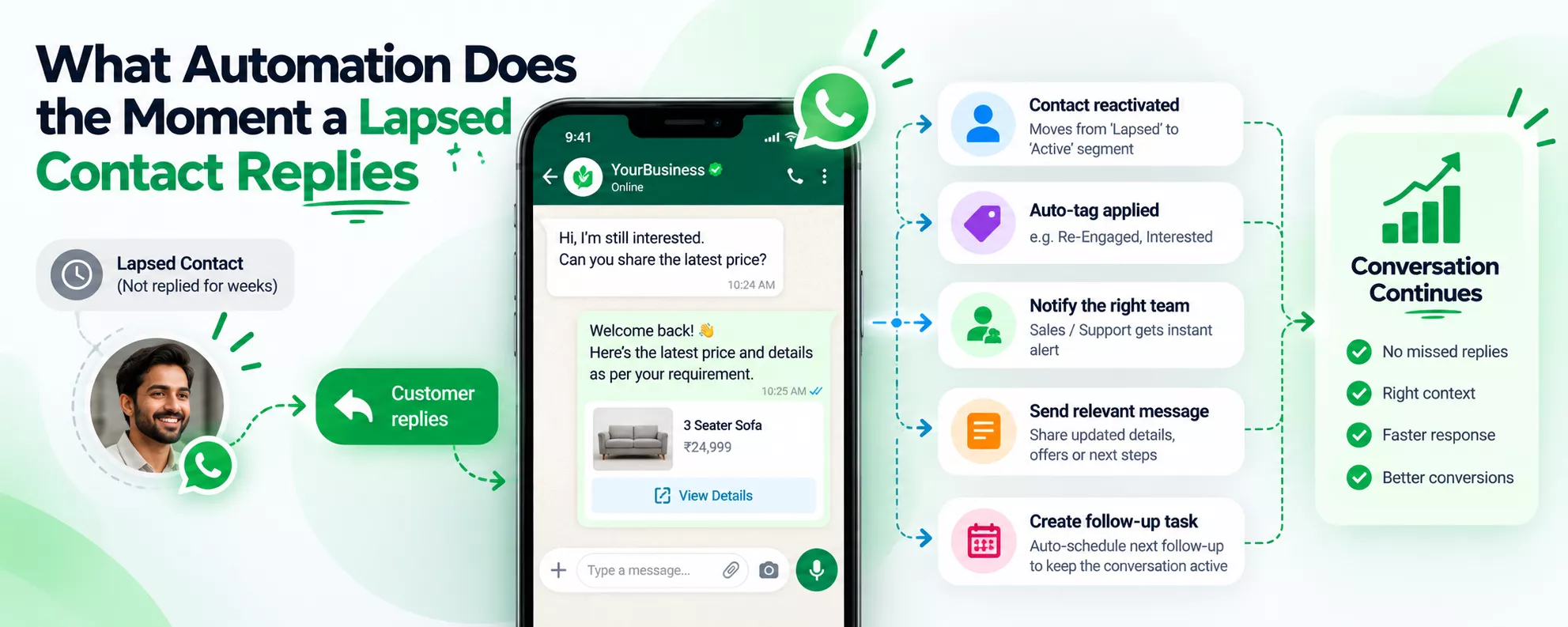
A lapsed contact who replies to a re-engagement message is in an active decision window. The reply itself signals renewed interest. What happens in the next few minutes determines whether that window stays open or closes again.
Automated reply flows catch these replies immediately — regardless of whether the re-engagement campaign went out at 10 AM or 9 PM. The flow acknowledges the reply, asks a focused qualifying question to understand where the contact is now relative to when they last engaged, and either provides the relevant next step or flags the conversation for a human agent with the re-engagement context attached.
The qualifying question is important. A contact who has been quiet for three months may have a different situation than they did before — a new budget, a changed requirement, a new decision-maker involved. The automation collects updated context rather than assuming the original conversation still applies. The human agent who picks up the conversation gets both the original history and the current context.
The Inbox Structure That Keeps Re-Engaged Contacts From Getting Lost Again
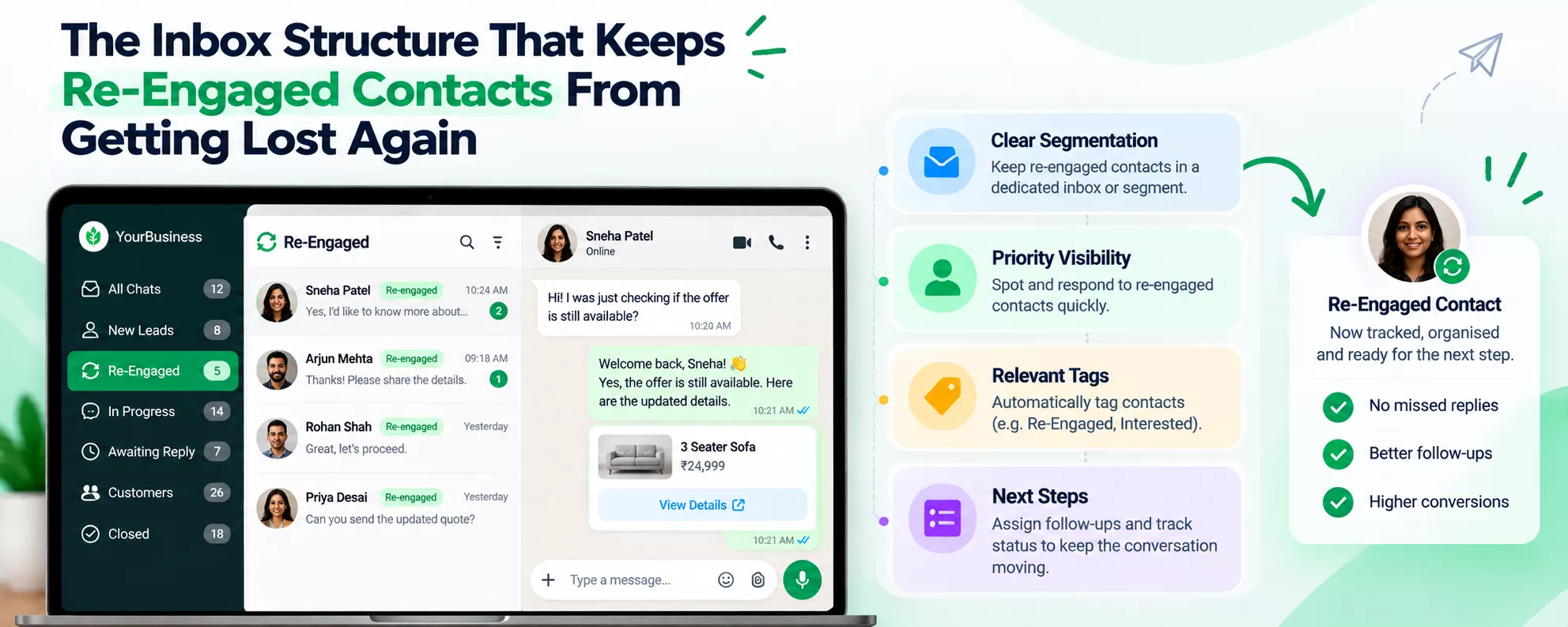
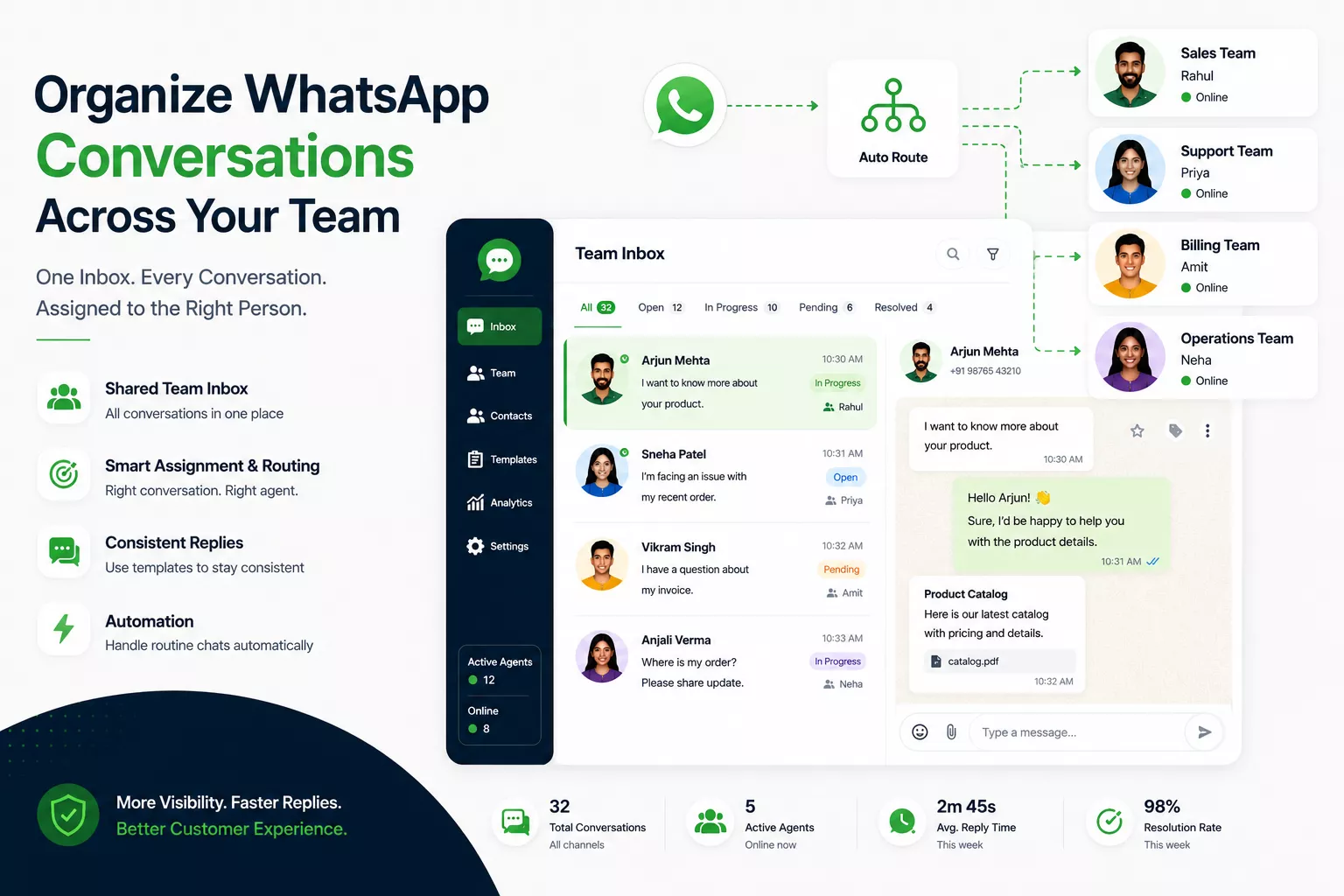
A re-engagement campaign can generate dozens of replies across a few days, arriving at unpredictable times. Without inbox structure, these replies mix with new enquiries, active conversations, and ongoing support threads. A re-engaged contact whose reply sits unassigned in a general queue for six hours has the same experience as the contact who was never followed up on in the first place.
A multi-agent inbox with routing rules solves this. Re-engagement campaign replies can be tagged automatically and routed to a specific agent or team designated to handle them. The agent opens that thread knowing it came from a re-engagement sequence — they can see the original conversation history, the lapse period, and what the re-engagement message said. Their first response continues from an informed position rather than a cold start.
Priority flags ensure that high-value contacts who respond to re-engagement — contacts who had large enquiries or were far along in a previous sales conversation — are surfaced to senior agents before lower-priority responses. The re-engagement effort compounds because the infrastructure converts replies into properly managed conversations rather than letting them dissolve into the general queue.
Re-engaging customers who stopped replying is not about sending more messages into the void. It is about building a system where the right message reaches the right person at the right time, the reply is met immediately, and the conversation that follows is handled with the context that makes it worth having. At 24/7 Marketing, that is exactly the system we build.
Ready to bring your silent contacts back into conversation? Visit 247marketing.in.